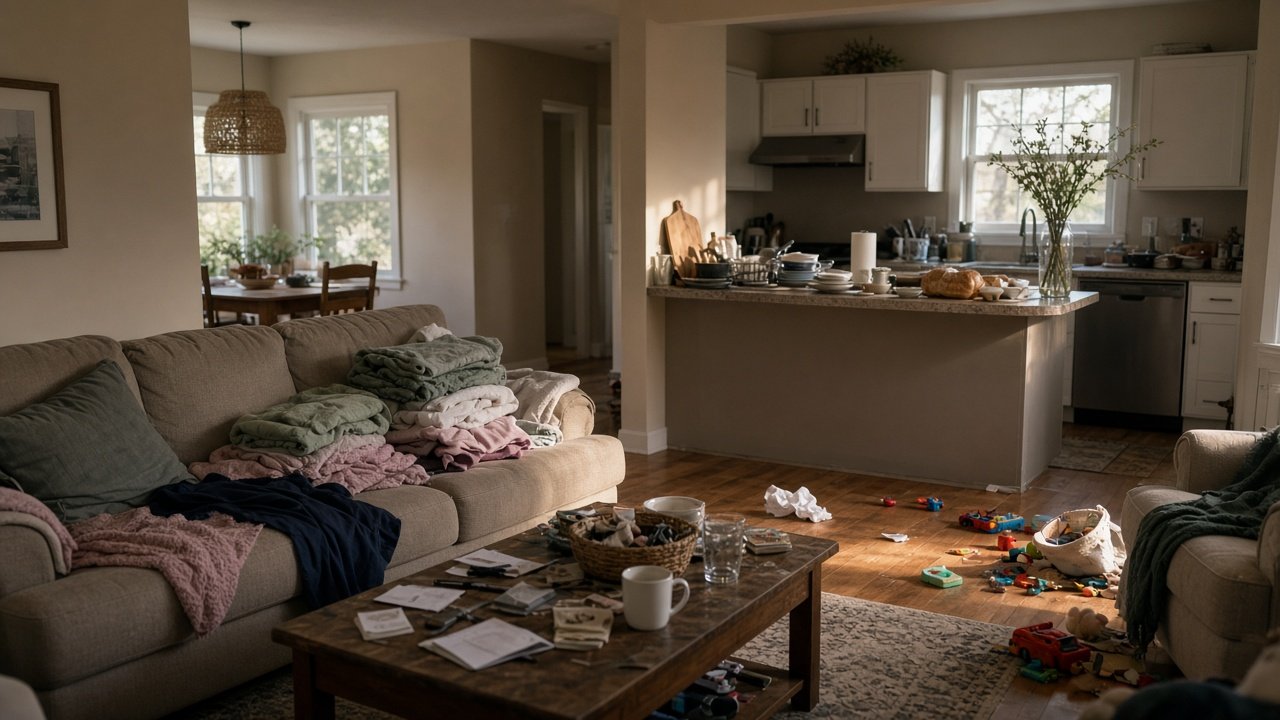
The doorbell rings and your stomach drops.
You know the feeling. The quick scan of the living room. The laundry on the couch. The mail on the counter. The thought that hits before you even open the door: What is wrong with me?
If you’re ashamed of your house right now, let’s start here. Nothing is wrong with you. You’re managing a lot of roles with limited energy, in a world that expects everyone to do everything perfectly and make it look effortless. The state of your home doesn’t define your worth. Not even a little.
Shame is a terrible motivator
You’d think feeling bad about the clutter would push you to deal with it. It almost never does.
Shame makes you avoid. You stop looking at the counter. You keep the guest room door shut. You say no to people coming over. And the less you look, the heavier it gets, until the pile isn’t a pile anymore. It’s evidence. Proof, in your head, that you’re failing at something everyone else manages.
But here’s what I want you to know: your clutter isn’t evidence that you’re failing. It’s evidence that you’re human, busy, and carrying more than anyone should have to carry alone.
The comparison trap
“My friend’s house is always spotless. Why can’t I manage that?”
Your friend has different circumstances, different priorities, or a closet stuffed with everything she grabbed before you arrived. (True story. Most people do this.) Comparing your real life to someone else’s curated version is like comparing your blooper reel to their highlight reel.
Real homes look lived-in because real people live in them.
Swap the shame story for honest noticing
In the book, this step is called Awareness, and it’s simpler than it sounds. Walk through one room like a kind friend seeing it for the first time.
Here’s the shame story: This is disgusting. How did I let it get this bad?
Here’s the honest version: There are dishes in the sink from this morning. Clean laundry in a basket on the couch. Mail piled on the counter. These are signs of a busy life, not a failed person.
Do you feel the difference? One crushes you. The other informs you.
Your clutter is information, not a verdict
Clutter patterns usually point to life patterns. A few examples:
-
A chaotic kitchen counter often means you come home too tired to put things away. That’s an energy problem, not a character flaw.
-
A pile on the bedroom floor often means your closet doesn’t actually have room for your clothes.
-
An overflowing junk drawer usually means small things don’t have a home yet.
-
A mountain of mail is decision fatigue around paper. Super common. Super fixable.
If your brain works differently, like mine, you might also notice visible piles because out of sight means out of mind. That isn’t laziness either. It means you need systems you can see. Design for the brain you actually have, not the one you wish you had.
Three questions for one room
Pick one room. Not the whole house. Stand in the doorway and ask:
-
What already works here? Notice this first. You’re not starting from zero.
-
What creates friction? Be specific. “The bathroom is a mess” is vague. “I can’t find my toothbrush in the morning because the counter is full of products I don’t use” gives you something to act on.
-
What does this room need to do for me? A bedroom needs rest. A kitchen needs a clear spot to cook. That’s it.
Then, if you have it in you, do one 15-minute surface clear on the friction point you named. Trash, then Relocate, then Keep. If you don’t have it in you today, that’s okay too. Just noticing counts.
What Emma realized
Emma, a single parent finishing her master’s degree online, used to say her counter made her feel like she was failing. “Other parents seemed to have it together,” she told me.
Then she cleared one counter in 15 minutes, and something bigger shifted.
“I realized I’m not actually a disorganized person,” she said. “I’m a person with limited time and energy who was trying to do everything at once. When I gave myself permission to do just 15 minutes, I could actually succeed.”
A permission slip for you
You’re allowed to have a home that’s lived in. You’re allowed to start small. You’re allowed to stop when the timer rings, even if it’s not done.
And the next time the doorbell rings? Maybe your stomach still drops a little. That’s okay. You’re learning a new story about yourself, and new stories take time.
The shame-free approach in Clear Home, Calm Mind starts with clearing the emotional barriers before you touch a single item. Find the book at rsandar.com/book, and get the free CALM Starter Kit through the newsletter.
Related reading: Overwhelmed by Clutter? Start With One Surface and 15 Minutes · Clutter and Depression: Small Steps When Everything Feels Heavy